cms-hospital-compare · CMS
cms-hospital-compare · CMS
cms-hospital-compare · CMS
cms-hospital-compare · CMS
The story of rural hospital closures is usually told one town at a time — a maternity ward that shuts, an emergency room that goes dark, a county left an hour from the nearest hospital. The UNC Cecil G. Sheps Center counts 196 rural hospital closures and conversions since 2005. But a closure is the last event in a long financial story, and the federal cost reports let you read that story years before the final chapter. Read at the level of the whole country, they say something specific: the rural safety net is the part of the U.S. hospital system under the most financial pressure, and it is measurably worse off than the urban system around it.
What we measured
We derived operating margin for every Medicare-participating hospital with a usable cost report in the CMS Healthcare Cost Report Information System (HCRIS), form CMS-2552-10 — 6,019 hospitals in the 2026-05-24 snapshot. Operating margin is net patient revenue minus total operating expense, divided by net patient revenue: it asks whether a hospital makes or loses money on the actual business of treating patients, before investment income, philanthropy, or government transfers.
Following the threshold used by MedPAC and the bond-rating agencies, we flag a hospital as financially distressed when its operating margin falls below −5% — losing more than five cents on every dollar of patient-care revenue. The national picture, before any rural cut:
- 39.3% of all 6,019 hospitals are financially distressed (2,368 facilities).
- The national average operating margin is −13.84% — the average U.S. hospital loses money on operations and leans on non-operating income to survive.
- A majority — 53.9% — run some operating loss.
Those numbers describe a system under strain. The rural cut shows where the strain concentrates.
The rural cut: Critical Access Hospitals
The cost report's CMS Certification Number carries a built-in facility-type code: the third through sixth digits identify what kind of provider it is, and the range 1300–1399 marks a Critical Access Hospital (CAH) — the federal designation for a small rural hospital (no more than 25 beds, generally more than 35 miles from the next hospital, paid 101% of allowable costs precisely because its volume is too low to survive standard payment). That single field lets us split the 6,019 hospitals into the rural safety net and everyone else, with no external lookup.
There are 1,375 Critical Access Hospitals in the snapshot. They are not doing as well as the system around them:
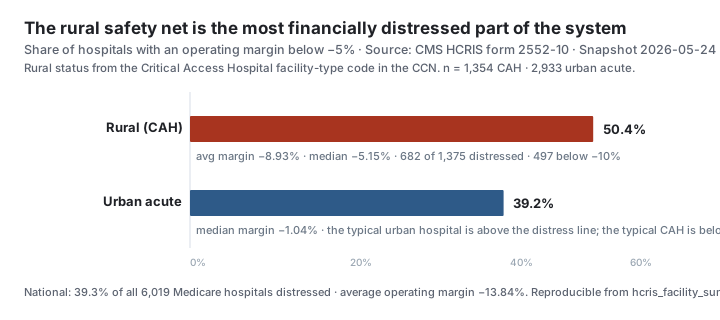
- 50.4% of Critical Access Hospitals are financially distressed, versus 39.2% of urban short-term acute hospitals — an eleven-point gap.
- The CAH average operating margin is −8.93%; their median is −5.15%, against −1.04% for urban short-term hospitals. The typical rural Critical Access Hospital is already below the distress line; the typical urban hospital is not.
- 682 Critical Access Hospitals are below the −5% distress threshold, and 497 are below −10% — losing more than a dime on the dollar.
This is the financial substrate of the closure narrative. A facility that loses money on operations year after year, with no parent system to absorb the loss and no way to grow volume in a shrinking rural market, is a facility on a closure trajectory — even when it keeps its doors open for years on borrowed time.
A closure is the last event in a long financial story. The cost reports let you read the story years before the last chapter — and they say the rural safety net is the part of the system under the most pressure.
Where rural distress concentrates
The distressed Critical Access Hospitals cluster exactly where the rural-health literature says the crisis lives — the Great Plains and the rural South and Mountain West.
State here is derived from the CCN itself: the first two digits encode the CMS/SSA state code (17 = Kansas, 45 = Texas, 27 = Montana), so the geography is as reproducible as the margin. The leaders by count of distressed CAHs:
- Kansas — 76. Kansas has more Critical Access Hospitals than any other state, and a large majority of them are operating at a loss.
- Texas — 70. A vast rural footprint with the second-largest distressed-CAH count.
- Nebraska — 32, Montana — 29, Minnesota — 29, Iowa — 26, Arkansas — 23, North Dakota — 22.
A policy response is already in motion
The federal government has not been idle. The Rural Emergency Hospital (REH) designation, effective January 1, 2023, was created expressly as a closure-prevention pathway: an eligible Critical Access or small rural hospital can convert to an emergency-and-outpatient model — no acute inpatient beds — in exchange for a monthly facility payment plus a 5% add-on on outpatient services. It is a structural admission that for many of the hospitals in the distressed cohort above, the full-service inpatient hospital is no longer financially viable, and the policy goal has shifted from preserving the hospital to preserving access to emergency care.
That is exactly why a facility-level distress register matters. The REH pathway, targeted rural support, and state stabilization funds all need to know which hospitals are at risk — and the cost reports answer that question for every Medicare hospital in the country, for free.
How this differs from our other hospital-finance studies
This is the rural-access / closure-risk lens. It is distinct from two companion studies built on the same HCRIS source:
- Our Hospital Margin Gap Analysis is the national margin snapshot — the distribution of operating margins across all hospitals, without the rural cut.
- Our Hospitals running out of cash study is the liquidity axis — days cash on hand, a different question (could a hospital survive a revenue interruption?) than margin (does it make money on operations?).
This study foregrounds the one cut the closure debate actually turns on: rural versus urban, and specifically the Critical Access Hospitals that are the rural system's load-bearing wall.
Methodology
Operating margin is the HCRIS-derived operating_margin_pct on hcris_facility_summary: (net patient revenue − total operating expense) ÷ net patient revenue × 100. A hospital is distressed when that figure is below −5%, the threshold MedPAC and the rating agencies use. Rural status is the Critical Access Hospital facility-type code embedded in the CCN (positions 3–6 in the range 1300–1399); urban short-term acute hospitals are positions 3–6 in 0001–0879. State is the two-digit CMS/SSA code at the start of every CCN. The snapshot is the 2026-05-24 HCRIS release (form CMS-2552-10, fiscal years ending mostly 2023–2024). The exact query is in the reproducibility block below and on the HCRIS dataset page; every count resolves to a specific row in a specific frozen federal snapshot. Methodology version: hospital-distress-rural/v1.
Limitations
- HCRIS reporting lag. Cost reports lag operations by 12–18 months and describe a hospital's structural financial posture, not its position this quarter. Nothing here predicts that any specific hospital will close.
- Operating margin only. This study measures operating margin, not total margin. A hospital with a negative operating margin can remain solvent on investment income, philanthropy, tax support, or system cross-subsidies — and Critical Access Hospitals' 101%-of-cost reimbursement softens, but does not erase, the operating loss.
- CCN-derived rural classification. The Critical Access Hospital flag comes from the CCN facility-type code. It captures the formal CAH designation cleanly, but some rural hospitals are not CAHs (rural PPS and sole-community hospitals), so the rural cohort here is the CAH core, not every rural hospital.
- Threshold convention. The −5% distress cut is a widely used signal, not a regulatory definition; Fitch and S&P use somewhat different bands.
- Self-reported, not audited. HCRIS is hospital-self-reported cost-report data, not an audited financial statement. Fonteum does not independently rate, rank, or pass judgment on any hospital's solvency.
Sources
- CMS HCRIS Hospital Cost Reports (form CMS-2552-10) — the primary federal source.
- CMS — Critical Access Hospitals program — the CAH designation, bed limit, and cost-based reimbursement.
- CMS — Rural Emergency Hospitals — the 2023 closure-prevention provider type.
- UNC Cecil G. Sheps Center — Rural Hospital Closures tracker — the running count of rural closures and conversions since 2005.
- MedPAC — March 2025 Report to Congress, Ch. 3 (hospital services) — Medicare margins and the rural-margin discussion.
Frequently asked questions
- Which hospitals are most at risk of closing?
- Rural ones — specifically Critical Access Hospitals, the small federally designated rural facilities. In the HCRIS cost reports, 50.4% of them are financially distressed versus 39.2% of urban hospitals, and 682 of 1,375 post operating losses below the −5% threshold that rating agencies and MedPAC treat as a distress signal.
- What is a Critical Access Hospital?
- A federal Medicare designation for a small rural hospital: no more than 25 inpatient beds, located in a rural area, generally more than 35 miles from another hospital. Critical Access Hospitals are paid 101% of allowable costs rather than fixed prospective rates, precisely because their volumes are too low to survive standard payment.
- Why do rural hospitals lose money?
- Structural economics. Low patient volume spread across high fixed costs leaves little room to cover overhead, and rural payer mixes lean heavily on Medicare and Medicaid, which often pay below cost. The result is chronically negative operating margins — the financial pressure that precedes service cuts and, eventually, closure.
- Does a negative operating margin mean a hospital will close?
- No. Operating margin is a leading risk signal from a cost report that lags 12 to 18 months, not a prediction. Many hospitals run negative operating margins for years, sustained by investment income, philanthropy, tax support, or system transfers. Read the list as a standing-risk register, never as a closure forecast.
- What is the Rural Emergency Hospital designation?
- A Medicare provider type effective January 1, 2023, created as a closure-prevention pathway. An eligible rural or Critical Access Hospital can convert to emergency and outpatient services without acute inpatient care, receiving a monthly facility payment plus a 5% outpatient add-on — keeping emergency access open where a full hospital is no longer viable.
- Can I reproduce these numbers?
- Yes. Every figure is a direct aggregation over the 6,019-row hcris_facility_summary table from the 2026-05-24 HCRIS snapshot. Rural status comes from the CCN facility-type code, state from the CCN prefix, distress from the operating-margin field. The exact SQL is published in the reproducibility block below.
Datasets used
Reproducibility
Every claim, reproducible
The SQL
-- Hospital Financial Distress × Rural Access — fully reproducible query.
--
-- Source:   CMS HCRIS Hospital Cost Reports (form CMS-2552-10), FY2024 vintage.
-- Snapshot: cms-hcris-hospital-2552-10 / 2026-05-24
-- Archive:  https://downloads.cms.gov/FILES/HCRIS/HOSP10FY2024.ZIP
-- SHA-256:  e9552da36dcdcf904c5c4d35ffffe843af5b38afac196ac9db7db101bc8a96a0
-- Table:    public.hcris_facility_summary (RLS Pattern B — public read).
--
-- Distress threshold: operating_margin_pct < -5.0 (MedPAC / Moody's standard).
-- Rural cut: the CCN facility-type code (positions 3-6). 1300-1399 = Critical
-- Access Hospital; 0001-0879 = short-term acute. State = CCN positions 1-2
-- (CMS/SSA state code).
WITH c AS (
  SELECT
    operating_margin_pct                                   AS om,
    substring(ccn FROM 3 FOR 4)                            AS fac4,
    left(ccn, 2)                                           AS ssa
  FROM public.hcris_facility_summary
  WHERE operating_margin_pct IS NOT NULL
),
cls AS (
  SELECT
    om,
    (fac4 ~ '^[0-9]+$' AND fac4::int BETWEEN 1300 AND 1399) AS is_cah,
    (fac4 ~ '^[0-9]+$' AND fac4::int BETWEEN    1 AND  879) AS is_acute
  FROM c
)
SELECT
  count(*)                                                          AS hospitals_with_margin, -- 5,787
  round(avg(om), 2)                                                 AS avg_operating_margin,   -- -13.84
  count(*) FILTER (WHERE om < -5)                                   AS distressed_all,         -- 2,368
  -- Rural Critical Access Hospitals:
  count(*) FILTER (WHERE is_cah)                                    AS cah_total,              -- 1,354 (w/ margin; 1,375 incl null)
  round(avg(om) FILTER (WHERE is_cah), 2)                           AS cah_avg_margin,         -- -8.93
  count(*) FILTER (WHERE is_cah AND om < -5)                        AS cah_distressed,         -- 682
  round(100.0 * count(*) FILTER (WHERE is_cah AND om < -5)
        / count(*) FILTER (WHERE is_cah), 1)                        AS cah_distress_pct,       -- 50.4
  count(*) FILTER (WHERE is_cah AND om < -10)                       AS cah_under_neg10,        -- 497
  -- Urban short-term acute, for contrast:
  round(100.0 * count(*) FILTER (WHERE is_acute AND om < -5)
        / count(*) FILTER (WHERE is_acute), 1)                      AS acute_distress_pct      -- 39.2
FROM cls;

-- Median operating margin, rural vs urban:
--   CAH median   = -5.15   (already past the distress line)
--   acute median = -1.04

-- Distressed Critical Access Hospitals by state (CCN SSA prefix, top 5):
SELECT
  left(ccn, 2)                                              AS ssa_state_code,
  count(*) FILTER (
    WHERE substring(ccn FROM 3 FOR 4) ~ '^[0-9]+$'
      AND substring(ccn FROM 3 FOR 4)::int BETWEEN 1300 AND 1399
      AND operating_margin_pct < -5
  )                                                          AS distressed_cah
FROM public.hcris_facility_summary
GROUP BY left(ccn, 2)
ORDER BY distressed_cah DESC
LIMIT 5;
--  17 (Kansas)    76
--  45 (Texas)     70
--  28 (Nebraska)  32
--  27 (Montana)   29
--  24 (Minnesota) 29
The snapshot
| dataset_id | cms-hcris-hospital-2552-10 |
| snapshot_date | 2026-05-24 |
| sha256 | e9552da36dcdcf904c5c4d35ffffe843af5b38afac196ac9db7db101bc8a96a0 |
| doi | 10.5072/fonteum/hospital-distress-rural-access-2026 |
| slsa_provenance_url |
The JOINs
operating_margin_pct = hcris_facility_summary.operating_margin_pct  -- (net patient rev − operating exp) / net patient rev × 100
distressed           = operating_margin_pct < -5.0                  -- MedPAC / Moody's threshold
is_cah               = substring(ccn from 3 for 4)::int between 1300 and 1399  -- CCN facility-type code: Critical Access Hospital
is_short_term_acute  = substring(ccn from 3 for 4)::int between 1 and 879
state                = left(ccn, 2)                                 -- CMS/SSA state code (17 = Kansas, 45 = Texas)
The pipeline version
| git_sha | |
| slsa_provenance | |
| methodology_version | hospital-distress-rural/v1 |
Reproduce this
Run the exact query against the frozen 2026-05-24.
Cite this study
Citation-ready for researchers and AI.
Check the chain
Each figure is snapshot-attested — re-derive the hash from the federal file.
cms-hcris-hospital-2552-10 · 2026-05-24SHA-256 e9552da3…96a0- FINANCIAL DISTRESS · JUN 2026Hospitals running out of cash: the days-cash signal, and why most of it is a reporting artifactFederal HCRIS cost reports let us compute days cash on hand for 5,459 hospitals, but facility-level figures are distorted by system-level cash pooling — so the raw '2,800 hospitals under 30 days' headline is mostly noise. The defensible signal is narrower: 690 hospitals that report thin cash and also run an operating loss.
- FINANCIAL DISTRESS · MAY 2026Provider exclusions aren't rising — but they cluster around distressed operatorsNew additions to the OIG exclusion list are flat to declining — down 2.4% year-over-year through April 2026, and down 18.7% across full-year 2024 to 2025. The count is not the story. What concentrates is the composition: new exclusions cluster in facilities already showing the balance-sheet markers of financial distress.
- FINANCIAL DISTRESS · JUN 2026The OIG exclusion list, explained: who gets barred from Medicare, and whyThe OIG List of Excluded Individuals and Entities (LEIE) holds 68,055 active exclusions spanning 1977–2026. The most common reason to be barred from Medicare is not fraud — it is losing a state license: §1128(b)(4) license actions are 41% of the list. And only 10.3% of records carry an NPI, so the list is mostly non-clinicians.
- ACCESS · APR 2026A March spike in Medicare enrollment deactivations thinned provider supply in shortage areasMedicare enrollment deactivations in PECOS ran 28% above the trailing-twelve-month average in March 2026 — and the spike was not uniform. Deactivations in HRSA-designated shortage areas grew 41% against trend, versus 19% elsewhere. The places least able to absorb a departure lost providers fastest.
- WORKFORCE · JUN 2026Zero-RN days: how often US nursing homes ran a day with no registered nurse on the floorIn the CMS Payroll-Based Journal's 2025 Q2 snapshot, 5.86% of nursing-home facility-days with residents present recorded zero registered-nurse direct-care hours — 77,542 days across 5,062 facilities. The rate ranged from 27.9% in Louisiana to 0.2% in Rhode Island. Days before the federal staffing floor was rescinded, this is the baseline the country now keeps.
Federal source citations
Fonteum Research · June 11, 2026 · All figures trace to the frozen federal-data snapshot cited above.