oig-leie · CMS
oig-leie · CMS
oig-leie · CMS
oig-leie · CMS
The OIG List of Excluded Individuals and Entities — the LEIE — is the federal government's master record of who may not bill Medicare, Medicaid, or any other federal health program. It is maintained by the U.S. Department of Health and Human Services Office of Inspector General under the authority of Section 1128 of the Social Security Act (42 U.S.C. § 1320a-7), and the OIG republishes the full dataset monthly. As of the 2026-05-08 release, it holds 68,055 active exclusion records stretching back to 1977 — a 49-year accumulation of barred providers, suppliers, and individuals.
Almost everything most people believe about the list is shaped by the word fraud. The data tells a more specific, and more useful, story.
The single biggest reason is losing a license, not committing fraud
The exclusion that lands most people on the LEIE is §1128(b)(4) — revocation, suspension, or surrender of a state health-care license. It accounts for 27,907 records, or 41.0% of the entire list — larger than every fraud-conviction basis combined.
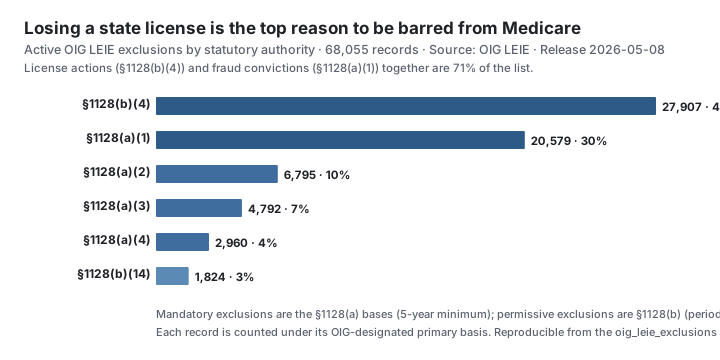
The structural reason is mechanical. Section 1128(b)(4) lets the OIG exclude anyone whose license to provide health care has been revoked, suspended, or surrendered by any state licensing authority. Every state board action — against a physician, nurse, pharmacist, dentist, social worker, or counselor, in any of the fifty states plus DC — is a potential feeder into the federal list. The volume of state disciplinary actions across every licensed profession dwarfs the comparatively narrow stream of federal program-fraud prosecutions. So the largest single category on a list most people associate with fraud is, in fact, a downstream record of state licensing discipline.
The popular picture of the exclusion list is a registry of convicted fraudsters. The data says otherwise — the single largest path onto the list is a state licensing board, not a federal courtroom.
Program-related fraud convictions — §1128(a)(1) — are the second-largest basis at 20,579 records (30.2%). Together, those two authorities account for 71% of every active exclusion. The remaining long tail covers patient-abuse or neglect convictions (§1128(a)(2), 6,795 records, 10.0%), felony health-care-fraud convictions (§1128(a)(3), 4,792, 7.0%), felony controlled-substance convictions (§1128(a)(4), 2,960, 4.4%), and a scatter of permissive bases including defaulted health-education loans (§1128(b)(14), 1,824, 2.7%).
Mandatory versus permissive: the two statutory tracks
Section 1128 splits exclusions into two tracks, and the split governs both who must be excluded and for how long.
Mandatory exclusions — §1128(a) — are the four bases the OIG has no discretion over. A conviction for a program-related crime (a)(1), patient abuse or neglect (a)(2), felony health-care fraud (a)(3), or a felony controlled-substance offense (a)(4) requires exclusion for a statutory minimum of five years. A second mandatory-exclusion offense raises the floor to ten years; a third makes exclusion permanent.
Permissive exclusions — §1128(b) — are discretionary. The OIG may exclude, and sets the period case by case. This track captures license actions (b)(4), misdemeanor fraud, kickback and Stark violations, false claims, and defaulted federal health-education loans, among roughly a dozen bases.
One record maps to one OIG-designated primary basis. A party with multiple underlying violations is still counted once, under the authority the OIG attached to the exclusion — so these category counts describe the reason of record, not every act behind it.The practical upshot is that the LEIE is not a uniform population. A §1128(a)(1) record is a federal fraud conviction with a hard five-year floor; a §1128(b)(4) record may be a license surrendered during a board inquiry with no criminal case at all. Reading the list as if every entry were a convicted fraudster misstates roughly half of it.
Who is actually on the list: the 10.3% NPI rate
Only 7,025 of the 68,055 records — 10.3% — carry a National Provider Identifier. This single fact reshapes how the list should be used.
The LEIE is not a physician registry. It covers every individual or entity that can touch a federal health program in any capacity: licensed clinicians, yes, but also durable-medical-equipment suppliers, home-health aides and personal-care attendants, billing and coding staff, pharmacy technicians, transportation providers, and facility owners. NPIs are issued to clinicians and certain organizations — not to most of those other roles. The 89.7% of records without an NPI are not physicians who lost an identifier; they are overwhelmingly parties who never held one.
For anyone building compliance tooling, the implication is blunt: matching the LEIE on NPI alone misses roughly nine in ten excluded parties. The OIG's own guidance is to screen against name, date of birth, address, and other identifiers — and to screen before hiring or contracting, and on an ongoing basis. Employing an excluded person in a federally billable role exposes the employer to civil monetary penalties under a "knew or should have known" standard, plus potential exclusion of the employing entity itself.
Where exclusions concentrate
State concentration tracks population and program size more than any per-capita propensity. California leads with 7,896 exclusions — 11.6% of the national total — followed by Florida (6,816, 10.0%), Texas (4,816, 7.1%), New York (3,538, 5.2%), and Ohio (3,166, 4.7%).
Three forces drive the geography. Larger states have more providers and more billing volume, producing more referral opportunities. States with large Medicaid programs generate more referrals from their Medicaid Fraud Control Units. And states with active licensing boards surface more §1128(b)(4) revocations into the federal list. California's 11.6% share does not mean California providers are more likely to be excluded per capita — it reflects the interaction of all three factors, and California is large on all three.
How to read a LEIE record
Each LEIE row carries the excluded party's name, the statutory basis (e.g. 1128b4), an exclusion date, and — where the OIG recorded one — an NPI, address, and date of birth. Reinstatement is not automatic when a term ends: a party must apply to the OIG and receive written notice that reinstatement was granted. A reinstated party is removed from the published list, which is why the LEIE is a snapshot of currently active exclusions rather than a cumulative history.
How this differs from our exclusion-trends study
This study is the reference layer — what the list is, who is on it, and under which authority. Our companion study, Provider exclusions aren't rising — but they cluster around distressed operators, is the analytical layer: it tracks how new additions move over time and shows they concentrate around operators already flagged by the cost reports as financially distressed. Read together, they cover the list's structure and its dynamics. Neither names or surfaces any individual excluded party — both are aggregate-only.
Methodology
All counts are direct aggregations over the oig_leie_exclusions table, populated from the OIG's monthly LEIE bulk download (release date 2026-05-08, ingested 2026-05-25, 68,055 records, RLS Pattern B — public read). Statutory-category counts use the OIG-published exclusion_type field. The NPI match rate is the share of rows with a non-empty npi value. State shares use the OIG-recorded state field. The date span is the minimum and maximum excl_date. The exact query is in the reproducibility block below and on the OIG LEIE dataset page; every count resolves to a specific row in a specific frozen federal snapshot. Methodology version: oig-leie-patterns/v1.
Limitations
- Snapshot, not cumulative. The LEIE lists currently active exclusions; reinstated parties are removed. These figures reflect the 2026-05-08 release and shift monthly.
- One basis per record. Category counts use the OIG's designated primary basis. A party's underlying conduct may span several violations.
- NPI coverage is a floor. The 10.3% reflects rows with a non-empty NPI field in OIG's published data; it does not prove the other 89.7% never held one.
- State counts are not per-capita rates. They reflect population, Medicaid program size, and licensing-board activity — not a propensity to be excluded.
- Not a quality metric, and aggregate-only. Exclusion counts are a compliance and enforcement signal, never a measure of care quality. No individual excluded party is named, surfaced, or attached to any provider profile in this study.
Sources
- OIG LEIE — online searchable database and monthly downloads — the primary federal source.
- OIG — exclusion authorities (§1128 mandatory vs permissive, minimum periods) — the statutory-basis reference.
- OIG — effect of an exclusion (screening duty, civil monetary penalties) — the compliance obligations.
- OIG — reinstatement — why exclusions do not lapse automatically.
- 42 U.S.C. § 1320a-7 (Social Security Act § 1128), full text — the governing statute.
Frequently asked questions
- What is the OIG exclusion list (LEIE)?
- The List of Excluded Individuals and Entities is the HHS Office of Inspector General's authoritative registry of people and organizations barred from federal health programs. No federal money may pay for any item or service an excluded party furnishes, directly or indirectly. The OIG updates it monthly.
- Why are most people excluded — fraud or something else?
- Something else. License revocation under §1128(b)(4) is the single largest basis at 41% of records (27,907). Program-related fraud convictions under §1128(a)(1) are second at 30%. The popular picture of a fraud registry is wrong: the most common path onto the list runs through a state licensing board.
- What is the difference between mandatory and permissive exclusion?
- Mandatory exclusions under §1128(a) follow convictions for program crimes, patient abuse, felony health fraud, or felony drug offenses, and carry a five-year minimum. Permissive exclusions under §1128(b) are discretionary — license actions, kickbacks, misdemeanors, defaulted health-education loans — with periods set case by case.
- Why do only 10.3% of records have an NPI?
- Because the list is not physician-only. It covers anyone who participates in a federal health program — billing agents, equipment suppliers, home-health aides, pharmacy technicians, owners. Most never held a National Provider Identifier, so screening compliance against NPI alone misses roughly nine in ten excluded parties.
- Does an exclusion end automatically when the term is up?
- No. Reinstatement is never automatic. An excluded party must apply to the OIG and receive written notice that reinstatement was granted before billing federal programs again. Obtaining a new Medicare provider number does not restore eligibility, and the party stays on the list until the OIG acts.
- Can I reproduce these numbers?
- Yes. Every figure is a direct count over the 68,055-record oig_leie_exclusions table from the 2026-05-08 OIG release. The exact SQL is published in the reproducibility block below and on the OIG LEIE dataset page. Each count resolves to specific rows in a specific frozen federal snapshot.
Datasets used
Reproducibility
Every claim, reproducible
The SQL
-- OIG Exclusion Patterns — fully reproducible query.
--
-- Source:   OIG List of Excluded Individuals and Entities (LEIE), monthly bulk download.
-- Snapshot: oig-leie / release 2026-05-08 (ingested 2026-05-25), 68,055 active records.
-- Table:    public.oig_leie_exclusions (RLS Pattern B — public read).
-- Authority: Social Security Act § 1128 / 42 U.S.C. § 1320a-7.
--
-- Every headline figure in the study resolves to one of the rows below.
WITH totals AS (
  SELECT
    count(*)                                                      AS total_records,
    count(*) FILTER (WHERE npi IS NOT NULL AND npi <> '')         AS npi_present,
    min(excl_date)                                               AS first_exclusion,
    max(excl_date)                                               AS latest_exclusion
  FROM public.oig_leie_exclusions
)
SELECT
  t.total_records,                                                          -- 68,055
  t.npi_present,                                                            -- 7,025
  round(100.0 * t.npi_present / t.total_records, 1)        AS npi_match_pct, -- 10.3%
  t.first_exclusion,                                                        -- 1977-07-01
  t.latest_exclusion                                                       -- 2026-05-20
FROM totals t;

-- Statutory-authority breakdown (top bases by volume):
SELECT
  trim(exclusion_type)                                       AS statutory_basis,
  count(*)                                                   AS records,
  round(100.0 * count(*) / sum(count(*)) OVER (), 2)         AS pct
FROM public.oig_leie_exclusions
GROUP BY trim(exclusion_type)
ORDER BY records DESC
LIMIT 8;
--  1128b4   27,907  41.01   license revocation / surrender
--  1128a1   20,579  30.24   program-related conviction
--  1128a2    6,795   9.98   patient abuse / neglect
--  1128a3    4,792   7.04   felony health-care fraud
--  1128a4    2,960   4.35   felony controlled substance
--  1128b14   1,824   2.68   default on health-education loan
--  ...                       (b4 + a1 = 71.25% of the list)

-- State concentration (top 5):
SELECT
  trim(state)                                               AS state,
  count(*)                                                  AS records,
  round(100.0 * count(*) / sum(count(*)) OVER (), 1)        AS pct
FROM public.oig_leie_exclusions
GROUP BY trim(state)
ORDER BY records DESC
LIMIT 5;
--  CA  7,896  11.6
--  FL  6,816  10.0
--  TX  4,816   7.1
--  NY  3,538   5.2
--  OH  3,166   4.7
The snapshot
| dataset_id | oig-leie |
| snapshot_date | 2026-05-08 |
| sha256 | |
| doi | 10.5072/fonteum/oig-exclusion-patterns-2026 |
| slsa_provenance_url |
The JOINs
total              = count(*) from oig_leie_exclusions  -- 68,055 active records
by_authority       = count(*) group by exclusion_type    -- §1128 statutory basis as published by OIG
npi_match_rate     = count(*) filter (where npi is not null and npi <> '') / count(*)  -- 7,025 / 68,055 = 10.3%
state_share        = count(*) group by state             -- CA 7,896 = 11.6% of national total
date_span          = min(excl_date) .. max(excl_date)    -- 1977-07-01 .. 2026-05-20
The pipeline version
| git_sha | |
| slsa_provenance | |
| methodology_version | oig-leie-patterns/v1 |
Reproduce this
Run the exact query against the frozen 2026-05-08.
Cite this study
Citation-ready for researchers and AI.
Check the chain
Each figure is snapshot-attested — re-derive the hash from the federal file.
oig-leie · 2026-05-08SHA-256 a3f1c9…7e6b- FINANCIAL DISTRESS · MAY 2026Provider exclusions aren't rising — but they cluster around distressed operatorsNew additions to the OIG exclusion list are flat to declining — down 2.4% year-over-year through April 2026, and down 18.7% across full-year 2024 to 2025. The count is not the story. What concentrates is the composition: new exclusions cluster in facilities already showing the balance-sheet markers of financial distress.
- FINANCIAL DISTRESS · JUN 2026Hospitals running out of cash: the days-cash signal, and why most of it is a reporting artifactFederal HCRIS cost reports let us compute days cash on hand for 5,459 hospitals, but facility-level figures are distorted by system-level cash pooling — so the raw '2,800 hospitals under 30 days' headline is mostly noise. The defensible signal is narrower: 690 hospitals that report thin cash and also run an operating loss.
- ACCESS · APR 2026A March spike in Medicare enrollment deactivations thinned provider supply in shortage areasMedicare enrollment deactivations in PECOS ran 28% above the trailing-twelve-month average in March 2026 — and the spike was not uniform. Deactivations in HRSA-designated shortage areas grew 41% against trend, versus 19% elsewhere. The places least able to absorb a departure lost providers fastest.
- CARE QUALITY · JUN 2026How fast do nursing homes fix what surveyors cite? 28.5 days for the harmful onesAcross 415,849 corrected CMS nursing home health deficiencies, the mean time from survey to documented correction is 32 days — but the harm-level citations, Severity G and above, close faster, in 28.5 days. The more severe the finding, the quicker the fix. Texas and Illinois correct in about two weeks; Washington, D.C. takes nine.
- CARE QUALITY · MAY 2026Why 14% of skilled nursing facilities had a quality drop in Q1Across 5,148 SNFs in Q1 2026, the composite quality score declined by an average of 0.06 points — but the decline was not evenly distributed. Facilities that changed ownership in the prior twelve months accounted for a disproportionate share of the slide.
Federal source citations
Fonteum Research · June 11, 2026 · All figures trace to the frozen federal-data snapshot cited above.